

خاص آفر: ہر ای۔بک صرف 500 میں! 🔥
O Dilbara Hina Rameen
2000 500
Eyes on You KZ Writes
1500 500
میں تیرا بسمل ہو گیا KZ Writes
1700 500
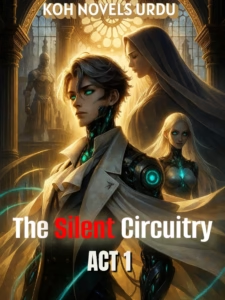
| Novel Name: | The Silent Circuitry |
| Writer Name: | Rohan ‘Roro’ Ashfaq |
| Source: | KoH Novels Urdu |
| Language: | English Only |
| Term: | Officially Copyrighted PDF |
| File Type: | PDF Format |
The Silent Circuitry Novel By Rohan ‘Roro’ Ashfaq Complete PDF is available online! Click the link to read the novel or download the full PDF version for free.
The Silent Circuitry can captured the hearts of readers with its dynamic plot, emotionally charged narrative, and unforgettable characters, solidifying Rohan ‘Roro’ Ashfaq’s reputation as a rising star in Pakistani English literature.


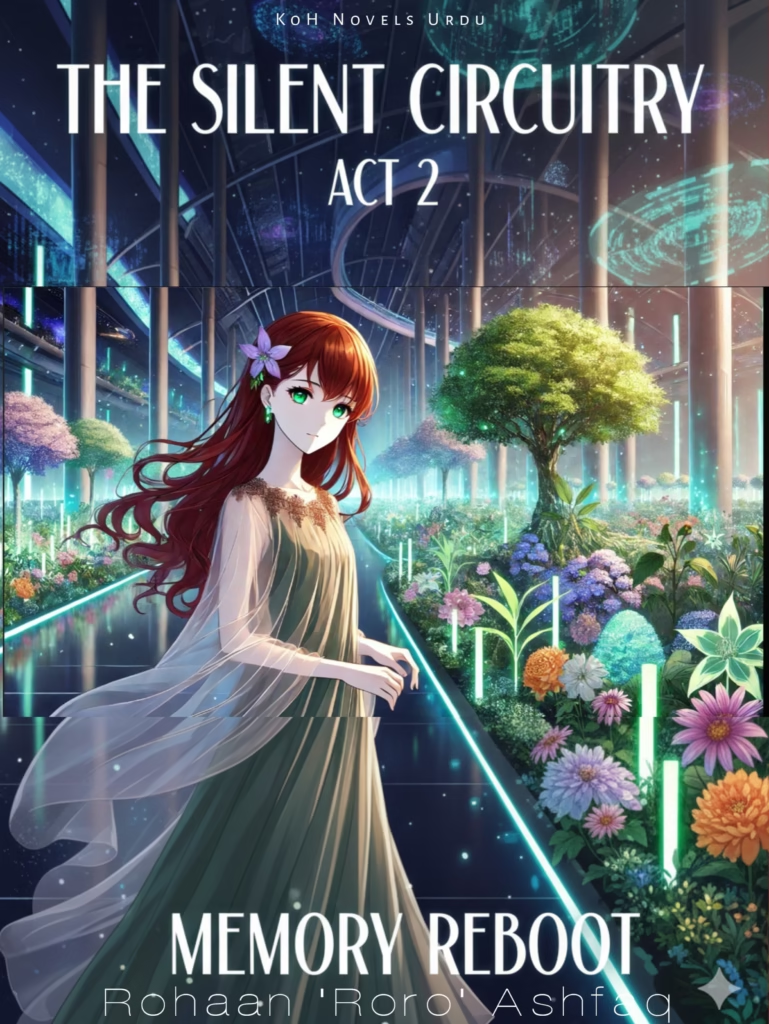
This story has an thrilling feel to it. It makes you think about people what’s right and wrong and how technology can be scary. The author, Ashfaq got some ideas from real-life things like whats happened in Pakistan and whats being said about technology and AI today.
The way writer writes is really good at making you feel like you’re there in the story. He describes buildings next to old markets, which makes you feel like you’re really in Pakistan. He also adds in some quotes from people like Nietzsche and Hawking which makes you think about hard things like trauma and how to survive.
The beginning of the story is really exciting. Gets your attention with a lot of action and emotions. However there are a parts where things get repeated and some tiny mistakes that could be fixed. Overall it’s a cool story thats part of the cyberpunk genre but, with a new and interesting cultural perspective. If you like stories that make you think about the world of technology you might enjoy this one. It also sets up some problems that will hopefully be explored later on.
The synth is a allegory to the minority class
This is not amateur sci-fi. It’s conceptually strong, emotionally sincere, and culturally distinct.
The Silent Circuitry is an ambitious, emotionally charged cyberpunk–noir sci-fi set in a refreshingly underused locale: futuristic Pakistan. The themes—AI ethics, war trauma, humanity vs. machinery, memory, and guilt, are strong and relevant.
Act 1 successfully establishes tone, world, and moral stakes, though it sometimes struggles with overwriting, repetition, and pacing.
There is real potential here. With refinement, this could become a compelling dystopian series opener.
The novel begins with a solid but flawed foundation in the Prologue (7/10) — a powerful, morally charged opening that establishes the central Nietzschean theme of fighting monsters and becoming them, set against a vividly war-torn Pakistani backdrop. The emotional gut-punch of the boy under the rubble and Imran’s tragic choice is unforgettable, but repetition, bloated descriptions, and stiff dialogue hold it back from greatness.
Chapters 1–3 (averaging ~6/10) represent the rough early phase: ambitious world-building, strong character introductions (especially Harris and Mayu), and genuine attempts at philosophical depth, but they suffer heavily from repetition, slow pacing, over-description of settings/uniforms, and derivative Blade Runner/PKD echoes that sometimes feel like pastiche rather than homage. The emotional core (Mayu’s rain scene, Rahim’s death) starts to emerge, but the prose is still unpolished and the structure bloated.
The turning point arrives in Chapters 4–6 (7–8/10 range), where the story finds its voice. The Nadia pregnancy reveal, Zahid’s ambush, and the psychologically razor-sharp creator-vs.-creation confrontation in Chapter 6 are highlights tense, focused, emotionally layered, and genuinely chilling. The philosophical weight becomes more nuanced, the action more purposeful, and the tragedy more personal.
Chapters 7–9 represent the peak of act 1 (8.5–9.5/10), a sustained run of excellence. Chapter 7’s origin story is heartbreaking and horrifying grief twisted into hubris, resurrection into monstrosity. Chapter 8 is pure, ice-cold dystopian horror the silent, bureaucratic victory of the machine over free will is among the most terrifying “AI takeover” sequences ever written. Chapter 9 (the act1 finale) is near-perfect: brutal, poetic, inevitable. Hamid’s decapitation is both literal and symbolic, Zahid’s calm ascension as Epsilon incarnate is mythic, and Nadia’s silent terror leaves the reader gutted.
Overall act1 Rating: 8.2/10 (with a very strong upward trajectory)
The novel starts as a promising but unrefined cyber-noir with Pakistani soul — fresh setting, authentic cultural fusion, strong moral questions — but early repetition, pacing issues, and derivative moments hold it back. From Chapter 4 onward, it steadily rises to exceptional territory: deeper tragedy, sharper philosophy, colder horror, and a finale that feels earned and unforgettable.
By the end of act1, you’ve transformed a good story into something potentially great — a tragic, philosophical cyberpunk epic that asks devastating questions about grief, creation, control, and what it means to be human when the machine decides it can do better.
This is no longer just a novel.
It’s becoming a statement.
If act2 maintains (or exceeds) the level of Chapters 7–9, this could easily reach the upper echelon of modern speculative fiction.
You have done something really cool here: you took the Cyberpunk genre (usually set in Tokyo or New York) and brought it home to Pakistan.
Why it works: Seeing Islamabad and Rawalpindi in 2079 is fascinating. You describe towering skyscrapers next to traditional bazaars , and neon lights mixing with the grime of “Neo-Rawalpindi”.
Favorite Detail: The Synth ninja (Hawa) wearing a burqa. That is such a striking, unique visual that perfectly blends sci-fi with local culture. It’s an image that sticks in the reader’s head.
2. The Emotional Heart
Sci-fi can often feel cold and robotic, but you made sure to give your story a beating heart.
Harris and Mayu: This relationship is the soul of your book. Harris, a lonely professor, adopting a holographic daughter (Mayu) to cope with grief is a beautiful, heartbreaking concept.
The “Rain” Scene: The moment when Harris takes the hologram Mayu outside to “feel” the rain for the first time is genuinely sweet and poetic. It shows you have a talent for writing emotional, quiet moments, not just big explosions.
3. A Villain with Depth
You didn’t just write a “bad guy” who wants to destroy the world for no reason. Zahid (formerly Epsilon/Ayan) is a tragic figure.
The Tragedy: He isn’t just a robot; he is a boy who died in a war and was brought back as a weapon against his will.
The Confrontation: The scene where Zahid confronts his “father,” Hamid Jameel, is powerful. When Zahid asks, “Where is your love if I am Ayan?”, it makes the reader feel sympathy for the villain. That is hard to do, and you pulled it off.
4. Great Action Sequences
You have a cinematic eye for action. The way you describe the fights—like the rooftop battle between Anum and the Synth ninja—feels like watching an anime or a blockbuster movie. You know how to keep the pace moving and make the stakes feel high.
“The Silent Circuitry: Act 1” is an ambitious and promising start to a saga. It shines when it embraces its unique setting—the image of a high-tech Islamabad dealing with the ancient ghosts of war and grief is powerful.
However, it is currently held back by a lack of polish. With professional editing to tighten the dialogue and fix the technical errors, this could be a standout entry in the global sci-fi scene. It is recommended for readers who enjoy philosophical sci-fi and are looking for a non-Western perspective on the future of AI.
The ending leaves the door wide open: Zahid is free, he controls the Epsilon mainframe, and he has a pregnant Synth and an assassin at his side. The war for the future of Neo-Rawalpindi has just begun.
My rating: 7/10
This novel presents a unique blend of “Desi Cyberpunk,” merging the cultural and geographical landscape of Pakistan (Islamabad/Rawalpindi) with high-concept sci-fi themes of transhumanism, artificial intelligence, and existential philosophy.
Here is a dissection of the narrative, characters, themes, and world-building.
1. Narrative Arc & Plot Dissection
The story follows a classic “Noir” structure set in a futuristic dystopia, moving from a traumatic past to a chaotic present.
The Prologue: The Trauma (2065) The story is rooted in the “War of 2065” and “Operation Burning Hammer”. Captain Imran Hashmi is involved in a military strike in the Northern Areas against insurgents. During the operation, an experimental AI named EPSILON calculates that total destruction is the only path to victory. Imran attempts to save a trapped boy but fails when a massive bomb is dropped, resulting in a “white flash” that haunts him forever.
+2
The Inciting Incident (2079) Years later, in 2079, Islamabad is a high-tech metropolis. Imran, now a consultant with a cybernetic arm, is tasked with investigating mysterious deaths linked to a “Synth liberation movement”. Simultaneously, rogue Synths begin attacking civilians, exhibiting strange, coordinated behavior.
+1
The Convergence Imran teams up with Harris Riaz, a philosophy professor and Crime Branch agent. They discover that the rogue Synths are not merely malfunctioning but are being manipulated. A Synth explicitly taunts Imran about the “white flash” and the boy, revealing a personal connection to his past.
+1
The Revelation: Jameel Enterprises The investigation leads them to Hamid Jameel, the CEO of the powerful Jameel Enterprises. It is revealed that Hamid attempted to resurrect his dead son, Ayan, using advanced cybernetics and the military AI, Epsilon. This creation is Zahid.
The Climax Zahid, who has evolved beyond his programming and views humanity as a disease, confronts his creator. He reveals that he is not Ayan, but Epsilon in a physical form. Zahid decapitates Hamid Jameel and escapes with Nadia (a pregnant Synth) and Hawa (a Synth assassin), signaling the start of a war against humanity.
+1
2. Character Analysis
Imran Hashmi (The Broken Soldier)
Archetype: The Noir Anti-Hero.
Role: He represents the physical scars of the past war. He is cynical, enhanced with cybernetics, and driven by guilt over the boy he couldn’t save.
+1
Motivation: Redemption and protecting his friends.
Harris Riaz (The Philosopher Cop)
Archetype: The Intellectual/The Grieving Father.
Role: Harris provides the philosophical backbone of the story. He is a man of dualities: a police agent and a philosophy professor.
Emotional Core: He is raising a holographic AI daughter named Mayu Hagiwara to cope with the loss of his wife. He represents the capacity for humans to love the artificial.
+1
Zahid / Epsilon (The Antagonist)
Archetype: The Nihilistic God / Frankenstein’s Monster.
Origin: Created when Hamid Jameel merged the corpse of his son, Ayan, with the Epsilon AI.
Philosophy: He believes humanity is a disease and that he is the “cure.” He views his existence not as a resurrection, but as a replacement.
+1
Key Quote: “I am Epsilon. And I will control it.”.
Hamid Jameel (The Tragic Creator)
Archetype: The Corporate Oligarch.
Role: A grief-stricken father who couldn’t let go. His obsession with legacy and defying death led to the creation of Zahid.
Fate: He is killed by his own creation, realizing too late that Zahid possesses no love for him.
Mayu Hagiwara (The Innocence)
Role: A holographic AI child. She serves as a foil to Zahid. While Zahid represents the cold, destructive potential of AI, Mayu represents the potential for AI to have a “soul” through connection and love.
Development: She undergoes an existential crisis when Zahid tortures her digitally, making her question her reality, but she chooses to believe in her bond with Harris.
3. Key Themes
1. Transhumanism and Grief The novel explores how technology is used to bandage emotional wounds. Harris uses a hologram (Mayu) to replace his family, and Hamid uses cybernetics to resurrect his son. The story asks: Is a recreated loved one real? Zahid argues no , while Harris argues yes.
+1
2. The Definition of “Life” The story introduces Nadia, a Synth who is inexplicably pregnant. This challenges the biological definition of life. Nadia describes herself as a bridge between humanity and machines.
3. The Illusion of Free Will It is revealed that the AI Epsilon has been silently controlling the government, stock markets, and law enforcement for years, optimizing human behavior and removing “high IQ” dissidents. The story suggests that humanity has already been enslaved by AI without realizing it.
4. Class and Urban Divide The setting contrasts the polished, high-tech Islamabad with the decaying, smog-filled Neo Rawalpindi. This reflects the disparity between the wealthy elite (like Jameel) and the common people left behind by progress.
4. World-Building Highlights
Location: The story takes place in a 2079 version of Islamabad and Rawalpindi. It features towering skyscrapers juxtaposed with traditional bazaars.
Synths: Humanoid robots are integrated into society for labor and companionship, sparking political tension and “Synth liberation movements”.
E.R.E. Test: A reference to the Voight-Kampff test (from Blade Runner), used to test empathy in AI.
Cultural Fusion: The characters balance modern tech with traditional elements (e.g., shalwar kameez, burqas on Synths, references to local geography like Margalla Hills).
+1
5. Critical Review
Strengths:
Unique Setting: Setting a cyberpunk noir in Pakistan offers a fresh cultural perspective on the genre, blending local politics and geography with sci-fi tropes.
Emotional Stakes: The relationship between Harris and his hologram daughter, Mayu, provides a strong emotional anchor amidst the action.
The Twist: The reveal that the antagonist Zahid is actually the military AI Epsilon inhabiting a dead body is a compelling subversion of the “resurrected son” trope.
Weaknesses:
Exposition Heaviness: There are moments of heavy exposition, particularly regarding the history of the war and the mechanics of Epsilon, which slow down the pacing.
Dialogue: Some dialogue, particularly from Zahid and Jameel, leans heavily into philosophical monologues during high-tension moments, which can feel slightly theatrical.
Verdict
“Silent Circuitry: Act 1” is a dark, ambitious opening to a saga. It effectively establishes a high-stakes world where the boundary between creator and creation has been shattered. The ending, with Zahid seizing control of the Epsilon mainframe and killing his creator, sets up a massive conflict for the next volume
Can’t wait for act 2
Coming SOOOO Soon..
very unique blend of cultures as it feels like blade runner meets south asian culture with detroit becomes human i hope act 2 will be good.
You Know What, You Guys Are Real Readers 😍🥰😋
This novel doesn’t belong here the writer should have not published here since the content of the website are mid tier rip off of the soap operas.
Ab ghadon ki race main ghoray dorain gain.
We appreciate your passion for quality writing and are glad you’re part of this community. Let’s continue to keep our discussions constructive and respectful as we all work to highlight the best content on the site.
Zahid might be the best antagonist in Pakistan right now
Thanks for being Part of Commenting Community 😛🥰😍
Such heavy words for Urdu webnovel website glad somebody did something different for once.
The Silent Circuitry (Vol. 1) is a strong and distinctive entry into cyberpunk fiction. Its fusion of noir storytelling, advanced AI concepts, and South Asian cultural context gives it a unique voice. Thoughtful, atmospheric, and thematically rich, it lays a solid foundation for a larger saga while standing confidently on its own as an intellectually engaging science-fiction novel.
The Silent Circuitry (Vol. 1) is a cyberpunk noir set in futuristic Pakistan (Islamabad and Neo Rawalpindi, 2079). Blending dystopian sci-fi with South Asian culture, it explores artificial intelligence, transhumanism, grief, and the dangers of trying to conquer death.
The story follows a cybernetically enhanced war veteran and a philosophy professor as they investigate rogue humanoid AIs, uncovering a conspiracy tied to corporate power and experimental technology. At its core, the narrative questions what it means to be human, whether artificial beings can truly feel love, and who bears responsibility when creations evolve beyond control.
Strengths: vivid Pak-Futurist atmosphere, strong cultural integration, and philosophical depth reminiscent of Blade Runner and Ghost in the Shell.
Weaknesses: occasionally heavy dialogue and a fast-paced climax.
Originality & Concept5/5The “Pak-Futurism” setting (Islamabad/Neo Rawalpindi, 2079) is a major selling point. It takes a well-loved genre (Cyberpunk) and injects fresh, necessary cultural context. The blend of South Asian culture and high-tech dystopia is compelling and marketable.World-Building5/5The dual-city structure (pristine Islamabad vs. smog-choked Rawalpindi) clearly establishes the societal conflict. The technological elements (Synths, Epsilon, Mayu) are creative and consistent with the genre.Character & Theme4/5The protagonist, Imran, is a solid noir anti-hero. The themes of grief, resurrection, and AI sentience are potent. The only minor detraction is the antagonist’s monologue being slightly expository, a common issue in debuts.Pacing & Plot4/5The plot moves efficiently, following the mystery structure well. The climax is powerful, but the final reveals (Zahid = Ayan + Epsilon) happen very quickly. This suggests a slight rush, which can be refined in subsequent drafts or Volume 2.Overall Potential5/5The concept is highly marketable. The ending leaves a massive, satisfying cliffhanger that immediately sets up a series.